
Projects
Bulk Topsoil for a New Lawn: How Much, What Grade, and What We've Seen Go Wrong

A meaningful share of new-lawn topsoil orders are wrong in some way — too thin, wrong grade, or should have been fill dirt first. This guide is what we wish every first-time homeowner knew before ordering.
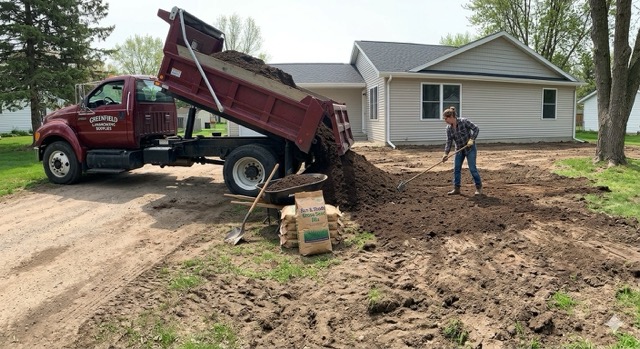
Spring and fall, we deliver topsoil for thousands of new lawns. A meaningful share of those orders are wrong in some way: too thin a layer, wrong grade, or ordered for a job that actually needed fill dirt first. This is the guide we wish we could send every first-time homeowner before they hit the order button.
The 30-second answer
For a new lawn over reasonable existing grade:
- Topsoil depth: 4 inches minimum, 6 inches is much better
- Grade to order: Screened topsoil (or garden mix if your budget allows)
- Math: Square footage ÷ 81 = cubic yards (for 4" depth)
- Cost: $25-55 per cubic yard delivered, varying by region
Example: A 1,000 sq ft new lawn area at 4 inches deep = 1,000 ÷ 81 = 12.3 cubic yards. Round up to 13 yards.
Calculate exact quantity and get a delivered price for your project. For everyone who wants the full picture and to avoid the common mistakes we see, keep reading.
How much topsoil for a new lawn — calculator approach
The formula:
Square footage × depth (in feet) ÷ 27 = cubic yards
Depth conversions:
- 2 inches = 0.17 ft
- 3 inches = 0.25 ft
- 4 inches = 0.33 ft (minimum for new lawn)
- 6 inches = 0.5 ft (recommended for new lawn)
Shortcuts (for 4" depth):
- Square footage ÷ 81 = cubic yards
- 1,000 sq ft = ~12 yards
- 2,000 sq ft = ~25 yards
- 5,000 sq ft = ~62 yards
Add 5-10% for settling. Topsoil compresses slightly after you spread and water it. A 4-inch fresh layer settles to about 3.5 inches over the first month. If you want a finished 4 inches, order for 4.5.
Grades of topsoil — what to actually order
Not all topsoil is the same. There are three quality grades:
Unscreened topsoil (cheapest)
Topsoil straight from the source. No filtering. Will have rocks, root pieces, occasionally trash from where it was scraped.
- Use it for: Large rough-grading projects where you'll till and pick out the rocks. Field rebuilding. Filling low areas before final topsoil.
- Don't use it for: A new lawn where you want to seed or sod directly. The rocks and lumps make it nearly impossible to get a smooth seedbed.
Screened topsoil (the standard)
Run through a mesh screen (typically 1/2" or 3/8") to remove rocks, roots, and debris. This is what most new lawns are built on.
- Use it for: New lawns, lawn repairs, top-dressing, most garden applications
- Don't use it for: Sand-based athletic fields (those need a specific spec) or specialty growing media
Garden mix / "premium topsoil" (best for new lawns)
Screened topsoil with compost or other organic amendments mixed in (typically 70% topsoil + 30% compost, but ratios vary by supplier).
- Use it for: New lawns where you want the best establishment, new garden beds, anywhere you're seeding or sodding
- Don't use it for: Anywhere with established mature plants (the high nitrogen from compost can burn them)
For a new lawn, our recommendation: garden mix if your budget can stretch to it (typically 20-40% more per yard than plain screened topsoil). The seed or sod establishes faster and the lawn looks better in year one. If budget is tight, screened topsoil works fine.
Should you order topsoil — or fill dirt first?
This is the most common mistake we see. Customers order topsoil to "raise the grade" of their yard, when they should have ordered fill dirt for the grade change and capped it with topsoil.
Decision tree:
| Your situation | What to order |
|---|---|
| Existing grade is good; just need lawn surface | Topsoil only (4-6") |
| Need to raise grade more than 2" | Fill dirt for grade + 4-6" topsoil on top |
| Filling a depression deeper than 4" | Fill dirt + topsoil cap |
| Replacing dead grass on a level yard | 2" topsoil amendment, tilled in |
| New construction with poor compacted subsoil | 6" topsoil minimum; consider rototilling 2" into the subsoil first |
| Raising a section by 6+ inches | Fill dirt for the grade change; topsoil on top |
The reasoning: topsoil compacts over time, more than people expect. If you put 8 inches of topsoil down to raise a low spot by 6 inches, it'll settle to about 6.5-7 inches within a year — and you've also spent more money than if you'd used cheaper fill dirt for the grade work.
For a deeper explanation of when to use which, see our guide on fill dirt vs. topsoil vs. fill sand.
A typical new lawn install
A common scenario we deliver to: a new-construction home where the builder left compacted clay subsoil with a thin (1-2") cap of poor-quality topsoil. The lawn that came with the house never established — patchy, weedy, mud after rain.
The plan: Strip the failing lawn down to bare subsoil. Till 2 inches into the clay to break up the compaction. Bring in screened topsoil at 4 inches depth. Add a 30% compost amendment in the top 2 inches. Seed in early fall.
Dimensions: Front yard 1,800 sq ft.
Materials ordered:
- 24 cubic yards of screened topsoil (= 1,800 ÷ 81 × 1.08 settling factor)
- 5 cubic yards of compost (mixed into top 2" by the contractor)
- Starter fertilizer and seed (sourced separately)
Outcome when done right: 8 weeks later, established lawn. By 12 months, a thick healthy lawn that holds up to traffic and drought.
The lesson: New construction lawns almost always need a real topsoil install. The 1-2 inches the builder leaves isn't enough. Doing it once at 4-6 inches is dramatically better than fighting a struggling lawn for years.
Common new-lawn topsoil mistakes
1. Too thin a layer (2" instead of 4"). Grass roots want to grow into healthy soil for the first 4-6 inches. With only 2" of topsoil over compacted subsoil, roots hit the hard layer fast and the lawn struggles in heat, drought, and high traffic.
2. Topsoil over compacted clay without breaking it up. If your subsoil is hard-packed clay (typical of new construction), spreading topsoil on top is like growing grass on a dinner plate. Till 2 inches into the clay before adding topsoil so roots have a path down.
3. Wrong grade (unscreened) for a new lawn. Unscreened topsoil has rocks and lumps that ruin a seedbed. Spend the extra $5-10 per yard for screened.
4. Skipping starter fertilizer. New lawns need phosphorus to develop roots. Most topsoil is low in phosphorus. Apply a starter fertilizer (look for "new lawn starter" — typically 18-24-12 N-P-K or similar) when you seed.
5. Topsoil over construction debris. If the builder buried wood scraps, sheetrock, or other debris in your yard, no amount of topsoil on top will fix the problem. Settling and chemical issues will haunt the lawn for years. If you suspect debris, dig test holes before ordering.
6. Wrong timing (mid-summer install with no irrigation). New lawns need consistent moisture for 4-6 weeks while establishing. Mid-summer installs without irrigation almost always fail. Best windows: early fall (best) or early spring.
7. Ordering by sq ft instead of cubic yards. We regularly see orders for "50 yards" when the customer's project actually needs 12. Or 5 when they need 25. Always calculate cubic yards using actual dimensions and intended depth.
8. Not testing pH before topsoil + seed. Cheap home pH test kit: $10. Lime or sulfur correction if needed: $20-50. Re-doing a failed lawn due to acidic or alkaline soil: $500-2,000. Test before you seed.
When NOT to order bulk topsoil
Bulk is not always the right answer:
Tiny lawns under 200 sq ft. Bagged topsoil from a home improvement store may be cheaper after you factor in delivery minimums. For an area this small, you might need only 2-3 yards — right at the bulk minimum.
Overseeding existing healthy lawn. Overseeding doesn't need full topsoil — just a thin layer of compost (1/4" max) raked into the existing turf. Bulk topsoil is overkill.
Just patching dead spots. For small repair patches under 50 sq ft total, bagged topsoil is more practical than a delivery.
Without equipment to spread. A yard of topsoil is about 27 cubic feet — enough to fill 13 standard wheelbarrows. If you're moving it all by hand, larger orders become exhausting fast. Consider hiring help or renting a small skid steer for spreading.
How to plan a new lawn install — step by step
- Test the soil pH and existing texture. $10 test kit, 30 minutes. Adjust with lime or sulfur if needed before topsoil arrives.
- Measure the area honestly. Length × width for rectangular areas; break irregular shapes into chunks.
- Decide on depth. 4" minimum, 6" better. Add 5-10% for settling.
- Decide on grade. Screened topsoil for budget; garden mix for best results.
- Calculate cubic yards. Square footage × depth in feet ÷ 27 = cubic yards.
- Plan delivery prep. Where will the topsoil pile go? Can your driveway handle the truck? See our delivery prep guide for details.
- Plan the spread. A yard is 27 cubic feet. Spreading 12-25 yards by hand takes a long time. Rent a small skid steer (~$200-300/day) for anything over 15 yards.
- Order topsoil 3-7 days before you plan to spread. Topsoil sitting in the rain for a week loses some quality.
- Spread, rake, level, lightly compact. A water-filled lawn roller works for the compact step.
- Seed (or sod), fertilize, water consistently for 4-6 weeks.
Frequently asked questions
How much topsoil do I need for a 1,000 sq ft lawn? For 4 inches of depth: 1,000 ÷ 81 = about 12 cubic yards. Add 10% for settling = order 13 yards. For 6 inches of depth: 19 cubic yards, round up to 20.
How deep should topsoil be for new grass? 4 inches minimum. 6 inches is significantly better, especially over poor or compacted subsoil. Anything less than 4 inches and grass roots will struggle when they hit the layer below.
What's the best topsoil for grass seed? Screened topsoil with compost amendment (often sold as "garden mix") gives the best establishment. Pure screened topsoil works fine. Avoid unscreened topsoil for a new lawn seedbed.
Should I till topsoil into existing soil? For most new lawn installs, lightly till 1-2 inches of topsoil into the top of the existing soil before adding the full 4-inch layer. This prevents a hard interface line where roots could get stuck.
Can I lay sod directly on topsoil? Yes, and this is the typical install. Roll out sod on freshly spread, lightly compacted topsoil. Water immediately and consistently for 2-3 weeks.
How much does bulk topsoil cost? $25-55 per cubic yard delivered, varying by region and grade. Premium garden mix runs $35-75 per yard. See our delivery cost breakdown for how pricing works.
What's the difference between topsoil and "garden mix"? Topsoil is the screened surface soil. Garden mix is topsoil blended with compost or other organic amendments. Garden mix has more nutrients and better texture for plant establishment but costs 20-40% more.
Do I need fill dirt under topsoil? Only if you're raising the grade more than 2 inches. For a lawn that just needs a topsoil surface over existing grade, no fill dirt needed. For grade changes, fill dirt under topsoil is cheaper and more stable than thick topsoil alone.
Calculate and order topsoil for your lawn
Ready to plan your install? Enter your lawn dimensions and ZIP in our topsoil calculator. You'll see:
- Exact cubic yards needed at your chosen depth
- Delivered price for your ZIP
- Recommended grade for your project
- Approximate delivery window
For large lawn projects, multi-property installs, or any case where you want a second opinion before ordering, send us your dimensions and our team will review.