
Guides
How to Prep for a Bulk Gravel Delivery: A Pre-Delivery Checklist

Most delivery problems are preventable in the 30 minutes before the truck arrives. Here's the access requirements, drop spot guidance, and the 10 most common problems we see at deliveries.
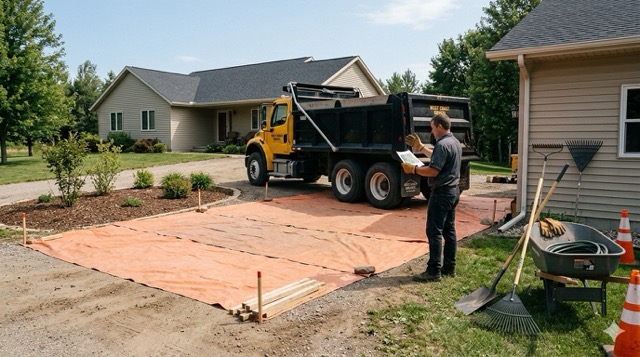
Most delivery problems are preventable in the 30 minutes before the truck arrives. This guide pulls together what our most experienced drivers want every customer to know before a bulk gravel delivery — access, drop spots, what to do during the drop, and the 10 most common problems we see.
Two days before — the access check
The truck has to physically get to your drop spot. "Drive up and dump" works fine for most driveways, but you need to verify three things before order day:
Driveway width. A standard dump truck is about 8 feet wide. You need 10 feet of usable clearance — 8 feet for the truck plus a foot of buffer on each side. A tri-axle truck (used for larger orders) needs 11-12 feet.
Measure your driveway at its narrowest point. Pull a tape measure. Don't eyeball it.
Overhead clearance. A loaded dump truck stands about 13-14 feet tall when the bed is up to dump. Tri-axle is taller. You need clearance for:
- Tree branches over the driveway
- Power lines, cable lines, telephone wires (especially old low-hanging ones)
- Gates or arch features
- Garage door openings if you want the drop close to the garage
If you have low overhead branches, our drivers won't risk it. They'll back out and we'll need to reschedule. Trim branches before the truck arrives if there's any doubt.
Soft ground. Loaded dump trucks weigh 40,000-60,000 pounds. They sink. If your driveway is gravel-on-soft-clay, or if your lawn is the only access path, soft ground is a real problem.
Signs of soft ground risk:
- Recent rain (within 48 hours) on a lawn or unpaved area
- Visible tire tracks from past deliveries
- Soft spots you can feel when walking
- Septic field anywhere near the access path (more on this below)
If you're worried about soft ground, plywood under the wheels can help. Ask dispatch about heavier-axle restrictions for your area.
One day before — pick the drop spot
Where should the truck dump the load? This is your decision, not the driver's. Drivers will follow your direction unless safety prevents it. Pick well.
Good drop spots have:
- Direct truck access (the truck can drive up, the bed can go up, the load drops out)
- A hard surface ideally (concrete, asphalt, or compacted gravel — NOT lawn or soft dirt if you can help it)
- Slight slope away from the dump spot so material doesn't roll back toward the truck
- Clear of overhead obstructions
- Close to where the material will actually be used (every foot of distance from the drop spot to the project means extra shoveling)
- Won't block your daily life (don't dump in front of the garage if you need to drive in)
Bad drop spots:
- On the lawn if it's been raining (ruts the entire yard)
- In front of the garage door if you need access
- Where the load will block a sidewalk, drainage, or path the trash truck uses
- On a slope steeper than 5% (load rolls toward you when dumped)
- Where you can't get equipment (wheelbarrow, skid steer, garden tractor) to it
Mark the spot. Two stakes, a paint mark, or a pile of cones works. Drivers are professionals, but they don't read minds. A marked spot eliminates guesswork.
The morning of — final checklist
- Drop spot marked clearly
- Cars moved off the driveway / out of the way
- Path to drop spot clear of toys, tools, hoses, etc.
- Gate open if the drop is past a gate
- Pets secured indoors (this matters — dump trucks are loud)
- You're available by phone
- If your dispatch text said a delivery window, you're home for it
You don't need to physically be present for most deliveries. But you should be reachable by phone in case the driver has a question ("the marked spot is on a slope — can I dump 5 feet to the left?").
Driveway protection — is it worth it?
Depends on your driveway and your tolerance for risk.
You probably don't need driveway protection if:
- Your driveway is concrete (40+ year life, dump trucks won't hurt it)
- Your driveway is asphalt in good condition (dump trucks have driven on countless asphalt driveways without issue)
- Your driveway is gravel that's well-compacted
Consider plywood or pads if:
- You have a new (less than 2 years) asphalt driveway and you're particularly cautious
- You have decorative stamped concrete or polished concrete (these are softer than standard concrete)
- You have brick or paver pavers (point loads from truck tires can crack pavers)
- You're delivering to a soft area you don't want compacted (lawn, soft gravel path)
How plywood works: Lay 3/4-inch CDX plywood sheets where the truck wheels will track. Two sheets, side by side, covering the wheel path. This distributes the load over a larger area and prevents point damage.
What to do during the drop
Stand clear. The driver will indicate where they want you, usually well away from the truck. Don't approach a truck with the bed up.
Don't try to direct the driver into a spot they're saying won't work. If the driver says "I can't fit through that gap," they're right. Don't argue. They'll find an alternative.
Watch the offload for any obvious quality issues. What you're looking for:
- Color and texture matches what you ordered
- Stone sizes look right (not way too big or too small) — our gravel sizes guide is a useful reference
- No obvious contamination (lots of dirt mixed in, organic matter, debris)
If something looks wrong, mention it before the truck leaves. Once they drive away, fixing a wrong-material delivery becomes much harder.
Don't tip unless you want to. Tipping the driver is optional. Some customers do; most don't. Drivers are paid by their company; tips are appreciated but never expected. If you do tip, $10-40 is typical for residential deliveries.
What to do AFTER the drop
Spread within 7 days if the load is on a driveway or any surface where you actually need to use it. Letting a gravel pile sit:
- Compacts the pile and makes it harder to spread
- Lets weeds sprout up through it if it's on bare soil
- Annoys the neighbors
- Blocks your driveway access if it's there
Cover with tarp if rain is coming AND material is grade-sensitive. Most gravel is fine in rain. Topsoil and DG can get a bit cementy if left in the rain, but it's not a disaster. Pure cosmetic issue.
Take a photo for your records. Quantity, location, time. If there's any dispute later about what was delivered, photos help.
The 10 most common delivery problems we see
Pulled from our actual support tickets:
1. Truck can't get in. Access issue not flagged before order. Driveway narrower than expected, overhead branches, or gates locked. Solution: re-confirm access before order day.
2. Customer not home, no clear drop spot marked. Driver has to guess or call. Solution: mark the spot, even if you'll be home.
3. Drop spot blocks the garage / mailbox / driveway. Customer realizes too late they can't get the car out. Solution: think about access for the next 1-7 days when picking the spot.
4. Soft lawn → truck damage. Truck tires sink into lawn after rain, ruts the yard. Solution: avoid lawn drop spots within 48 hours of rain.
5. Wrong material discovered after offload. Customer ordered crusher run, got #57 stone. Solution: watch the offload, verify material before the truck leaves.
6. Overhead wire too low. Driver has to refuse the drop. Solution: measure overhead clearance before ordering.
7. Customer realizes they ordered too much / too little. Calculator error or measurement mistake. Solution: double-check your calculation; for big orders, send dimensions to dispatch for review.
8. Septic field in the drop path. Heavy truck damages the septic field. Expensive repair. Solution: know where your septic field is and keep trucks off it.
9. Underground utilities not marked. Heavy load compresses or breaks a utility line. Solution: for any delivery where the truck will leave the existing driveway, call 811 to mark utilities first.
10. Steep driveway → driver concerns about safety. Driver refuses the drop because they can't safely get up the driveway. Solution: tell dispatch about a steep driveway when ordering so they can send the right truck.
When to call ahead and ask questions
If you're not sure your access will work, call dispatch BEFORE you order. Things to flag:
- Driveway under 10 feet wide at any point
- Steep grade (anything over 15% on the driveway)
- Overhead obstructions you're not sure about
- Soft, sandy, or recently-paved access path
- Multiple gates or chokepoints
- A drop spot that's NOT the main driveway (in the back yard, etc.)
- Septic field anywhere near the access path
- A property where you're not the owner (rental, contractor working for someone else)
Dispatch can route the right size truck or recommend a different delivery approach. The 10 minutes on the phone before ordering saves hours of frustration on delivery day.
Frequently asked questions
How wide does my driveway need to be for a gravel delivery? 10 feet minimum for a standard dump truck. 11-12 feet for a tri-axle truck. Measure at the narrowest point of the driveway, including any gate or arch.
Should I put plywood down before a dump truck delivery? For most asphalt or concrete driveways, no. For new (less than 2 years) asphalt, stamped concrete, pavers, or if you're concerned about damage, yes. Use 3/4-inch CDX plywood sheets where the wheels will track.
Can the truck dump on my lawn? Physically yes; practically often no. After rain, the truck will leave ruts and may not be able to back out. For lawn drops, the ground must be firm and dry. Ask dispatch about this before ordering.
Do I need to be home for the delivery? Not usually, if the drop spot is clearly marked and the driver has your phone number. For complex drops (specific yard locations, gated communities, etc.), being home is recommended.
What if I'm not happy with the drop location? Mention it immediately, before the truck leaves. If the driver dropped in the wrong spot, they may be able to relocate it (especially with a skid steer follow-up). After the truck leaves, you'll need to move the material yourself.
How long do I have to spread gravel after delivery? No hard deadline, but practically within 7-14 days. Longer than that and the pile compacts, weeds may sprout (if on soft ground), and you may annoy neighbors. For driveway drops, immediate to a few days is best.
Can you back into a residential driveway? For most deliveries, drivers will pull in head-first and dump on the way out (it's easier to maneuver). For long or narrow driveways, drivers may need to back in. Either way, the driver decides the approach based on safety and access.
Schedule a delivery
Ready to order? Enter your project dimensions and ZIP code in our gravel calculator. For complex access situations, contact dispatch first and we'll help you plan.